Showing posts with label Hans Christian Andersen. Show all posts

Friday, December 30, 2011

Paper Tales Exhibition in Hong Kong: The Snow Goddess


Here's an exhibit devoted to HCA's Snow Queen (here called Snow Goddess) in Hong Kong the past month. It is still showing until January 20th.

Press Release:

Magical Journey with Swire Island East’s Paper Tales

Swire Island East, in collaboration with the Hong Kong Youth Arts Foundation (YAF), presents Paper Tales – an awe-inspiring exhibition featuring delicate works from 11 local artists and 23 local students using paper as a medium to create objects of innovation and artistry. Led by the project’s main artist SumSum Tse, Paper Tales will be held at Swire Island East’s ArtisTree from 11 December 2011 to 20 January 2012.

Paper Tales flaunts mastery, originality and the divergent adaptability of paper. Artists let their imagination run wild to conceive idiosyncratic installation works, demonstrating complex paper-cutting and book-carving of great finesse. Visitors will see a medley of arresting paper art forms that is not limited to fine cutting and folding. An eccentric and spellbinding art anatomy is showcased, complemented by ambient music composed by Nick Harvey and special lighting effects by Wong Chiyung.

Inspired by Hans Christian Andersen’s Snow Goddess, Paper Tales is a magical journey in four chapters encompassing the poetic works of local creative force. The story begins with Pauline Yau’s maze-like Ice Tunnel of light and shadow. Weaving the way through the tunnel, visitors will arrive at Percy So’s Story-telling Installation. Four paper sculptures crafted in traditional paper art techniques unveil the legend of the Snow Goddess.

The tunnel finally opens up to a mysterious icy world. In a secluded setting, the Snow Goddess’s Crystal Palace produced by SumSum Tse emerges as the centrepiece of the exhibition. Visitors will be greeted by the mystical Snow Goddess in an animated projection casted above the Palace.

Teardrops of the affectionate Snow Goddess are transformed into eight Small World Dioramas of floating islands contriving a galactic abyss. Contributing artists include: Aeroporto, Margaret Chu, Graphic Airlines, Candice Keung, Hanison Lau, Salon de Pigeon and Tereza Tan. This section will also feature miniature sculptures created by local secondary students who learned from SumSum Tse through a series of workshops organised by YAF.

The exhibition also offers free guided tours and DIY ornament making workshops during which participants will learn to make crafted objects with used paper.
The images below came from an article at How to enjoy Christmas in Hong Kong while the poster came from the event site.


Pauline Yau makes fragile paper look menacing in her work "The Ice Tunnel."

Thursday, October 20, 2011

The Annotated Fairy Tale Books from Maria Tatar


The Annotated Classic Fairy Tales and the other two books in the series from Maria Tatar are another part of this month's library essentials. These are especially beneficial for the more casual but still enthusiastic fairy tale armchair scholar, filled with annotated versions of the tales and illustrations and other materials. It's rather like the SurLaLune site in book format and through a somewhat different perspective.

Book description from the publisher:

The Annotated Classic Fairy Tales is a remarkable treasure trove, a work that celebrates the best-loved tales of childhood and presents them through the vision of Maria Tatar, a leading authority in the field of folklore and children's literature. Into the woods with Little Red Riding Hood, up the beanstalk with Jack, and down through the depths of the ocean with the Little Mermaid, this volume takes us through many of the familiar paths of our folkloric heritage. Gathering together twenty-five of our most cherished fairy tales, including enduring classics like "Beauty and the Beast," "Jack and the Beanstalk," " ," and "Bluebead," Tatar expertly guides readers through the stories, exploring their historical origins, their cultural complexities, and their psychological effects. Offering new translations of the non-English stories by the likes of Hans Christian Andersen, Brothers Grimm, or Charles Perrault, Tatar captures the rhythms of oral storytelling and, with an extraordinary collection of over 300 often rare, mostly four-color paintings and drawings by celebrated illustrators such as Gustave Doré, George Cruikshank, and Maxfield Parrish, she expands our literary and visual sensibilities. As Tatar shows, few of us are aware of how profoundly fairy tales have influenced our culture. Disseminated across a wide variety of historical and contemporary media ranging from opera and drama to cinema and advertising, they constitute a vital part of our storytelling capital. What has kept them alive over the centuries is exactly what keeps life pulsing with vitality and variety: anxieties, fears, desires, romance, passion, and love. Up close and personal, fairy tales tell us about the quest for romance and riches, for power and privilege, and, most importantly, they show us a way out of the woods back to the safety and security of home. Challenging the notion that fairy tales should be read for their moral values and used to make good citizens of little children, Tatar demonstrates throughout how fairy tales can be seen as models for navigating reality, helping children to develop the wit and courage needed to survive in a world ruled by adults. This volume seeks to reclaim this powerful cultural legacy, presenting the stories that we all think we know while at the same time providing the historical contexts that unlock the mysteries of the tales. The Annotated Classic Fairy Tales is a volume that will rank as one of the finest fairy tale collections in many decades, a provocative and original work to be treasured by students, parents, and children. Over 300 often rare, mostly four-color paintings and drawings by celebrated illustrators.


The Annotated Brothers Grimm (The Annotated Books) description from the publisher:

The Annotated Brothers Grimm celebrates the richness and dramatic power of the legendary fables in the most spectacular and unusual Grimm volume in decades. Containing forty stories in new translations by Maria Tatar—including "Little Red Riding Hood," "Cinderella," "Snow White," and "Rapunzel"—the book also features 150 illustrations, many of them in color, by legendary painters such as George Cruikshank and Arthur Rackham; hundreds of annotations that explore the historical origins, cultural complexities, and psychological effects of these tales; and a biographical essay on the lives of Jacob and Wilhelm Grimm. Perhaps most noteworthy is Tatar's decision to include tales that were previously excised, including a few bawdy stories and others that were removed after the Grimms learned that parents were reading the book to their children—stories about cannibalism in times of famine and stories in which children die at the end. Enchanting and magical, The Annotated Brothers Grimm will cast its spell on children and adults alike for decades to come. 75 color and 75 black-and-white illustrations.


The Annotated Hans Christian Andersen (The Annotated Books) description from the publisher:

In her most ambitious annotated work to date, Maria Tatar celebrates the stories told by Denmark's "perfect wizard" and re-envisions Hans Christian Andersen as a writer who casts his spell on both children and adults. Andersen's most beloved tales, such as "The Emperor's New Clothes," "The Ugly Duckling," and "The Little Mermaid," are now joined by "The Shadow" and "Story of a Mother," mature stories that reveal his literary range and depth. Tatar captures the tales' unrivaled dramatic and visual power, showing exactly how Andersen became one of the world's ten most translated authors, along with Shakespeare, Dickens, and Marx. Lushly illustrated with more than one hundred fifty rare images, many in full color, by artists such as Arthur Rackham and Edmund Dulac, The Annotated Hans Christian Andersen will captivate readers with annotations that explore the rich social and cultural dimensions of the nineteenth century and construct a compelling portrait of a writer whose stories still fascinate us today.

Wednesday, August 31, 2011

My Fairytale: Theatre in Solvang, CA


I've previously written about Solvang and the musical, My Fairytale. The play finally had its USA premiere last week in Solvang and the reviews have been positive. There are some successful names behind the production, so that is encouraging. I only wish I still lived in LA so I could drive up and see the play.

About the musical from its press release:

PCPA Theaterfest is proud to present the American Premiere of My Fairytale, a musical about Hans Christian Andersen directed by Scott Schwartz. My Fairytale previews in Santa Maria August 12 - 20, then opens in Solvang’s Festival Theater running from August 26 through September 25, 2011.

The musical is an enchanted journey into the imagination of one of the worlds’ greatest storytellers - it’s a place of wonder, mystery and danger, and where Andersen is confronted by the characters from his fairytales. His quest is to find the Nightingale for the ailing Emperor, but he is continually kept him from his goal, being sidetracked by the fairytale characters, a boy, and a shadow.

My Fairytale was originally produced in Denmark in 2005 in honor of the bi-centennial of Hans Christian Andersen’s birth. Director Scott Schwartz pointed out that this first American production, besides being presented in English for the first time, includes the introduction of puppets, some script rewrites, and additional music by Stephen Schwartz, which will make My Fairytale feel more like a world premiere production. And, it will only be seen at PCPA.

This breathtaking production is filled with a powerful score created by Stephen Schwartz, the award-winning composer of Wicked. The book is by Philip LaZebnik (Pocahontas), and it was originally created by Flemming Enevold, the famous Danish actor and singer.


From My Fairytale at Solvang Festival Theater: U.S. Premiere of Musical Set in the Imagination of Hans Christian Andersen Plays Through September 25 by Charles Donelan:

With the terrific new musical My Fairytale, Solvang enters its second century through the cosmic portal of Hans Christian Andersen’s imagination. PCPA and producer Michael Jackowitz have assembled a brilliant team to design, direct, and perform the vision supplied by Stephen Schwartz (composer) and Philip LaZebnik (author). Beginning with the lifelong conflict that Andersen experienced between his ambition to produce serious works of theater and his propensity to spin out fairy tales with seemingly childish subjects, the show demonstrates that these aims are not merely compatible but complementary.

Andersen, who is wonderfully played and sung by Kevin Cahoon, crashes a reception for the singer Jenny Lind in the opening scene, only to be rebuffed when he indicates that he would like to write a show for Lind and that he intends to audition for the job by putting on a puppet show. Left alone overnight in the Royal Danish National Theater by the snobby board of directors, Andersen anticipates his scheduled morning meeting with the sympathetic Lind by literally diving into his imagination. After a rousing number called “Andersen’s Shadow,” two figures, Andersen and his Shadow (Erik Stein), tumble into the puppet case, only to emerge moments later in a fantasy world that’s entirely constructed out of the figments of Andersen’s overflowing imagination.

Information about tickets, location and dates can be found here.

Monday, July 11, 2011

The Soul Cages by Thomas Croker and Sting


The Soul Cages Mermaid and Other Water Spirit Tales From Around the World

Mermaid and Other Water Spirit Tales From Around the World has a slight connection to an album that was in standard rotation for me when I was in college, The Soul Cages by Sting. Sting's music was perfect for that period in my life.

As I gathered stories of mermaids, merrows and such, I came across The Soul Cages by Thomas Croker. It's a long story about souls being caged and rescued. Sting's version involves a demonic fisherman as the villain and Croker's tells of a merrow who cages the souls that are ultimately freed by Jack, the protagonist. You can read the lyrics to Sting's song here. The tale is not unique to County Kerry, Ireland, the source of Croker's tale. In his notes, for example, Croker includes a translation of a similar tale from Grimm’s Deutche Sagan (Croker's spelling, which should be Deutsche Sagen). And the question of souls is common in many mermaid tales, whether it be those of the merrow folk or captive humans. Even Hans Christian Andersen was inspired by the state of the immortal soul in his Little Mermaid which in itself led to the simplified Poor Unfortunate Souls in Disney's version of the tale.

But I'll stop there to make room for this long tale, notes not included, but the tale is fascinating all unto itself.


The Soul Cages
by Thomas Croker

JACK Dogherty lived on the coast of the county Clare. Jack was a fisherman, as his father and grandfather before him had been. Like them, too, he lived all alone (but for the wife), and just in the same spot. People used to wonder why the Dogherty family were so fond of that wild situation, so far away from all human kind, and in the midst of huge shattered rocks, with nothing but the wide ocean to look upon. But they had their own good reasons for it.

The place was just the only spot on that part of the coast where anybody could well live. There was a neat little creek, where a boat might lie as snug as a puffin in her nest, and out from this creek a ledge of sunken rocks ran into the sea. Now when the Atlantic, according to custom, was raging with a storm, and a good westerly wind was blowing strong on the coast, many a richly-laden ship went to pieces on these rocks; and then the fine bales of cotton and tobacco, and such like things, and the pipes of wine and the puncheons of rum, and the casks of brandy, and the kegs of Hollands that used to come ashore! Dunbeg Bay was just like a little estate to the Doghertys.

Not but they were kind and humane to a distressed sailor, if ever one had the good luck to get to land; and many a time indeed did Jack put out in his little corragh (which, though not quite equal to honest Andrew Hennessy’s canvas life-boat would breast the billows like any gannet), to lend a hand towards bringing off the crew from a wreck. But when the ship had gone to pieces, and the crew were all lost, who would blame Jack for picking up all he could find?

“And who is the worse of it?” said he. “For as to the king, God bless him! everybody knows he’s rich enough already without getting what’s floating in the sea.”

Jack, though such a hermit, was a good-natured, jolly fellow. No other, sure, could ever have coaxed Biddy Mahony to quit her father’s snug and warm house in the middle of the town of Ennis, and to go so many miles off to live among the rocks, with the seals and sea-gulls for next-door neighbours. But Biddy knew that Jack was the man for a woman who wished to be comfortable and happy; for to say nothing of the fish, Jack had the supplying of half the gentlemen’s houses of the country with the Godsends that came into the bay. And she was right in her choice; for no woman ate, drank, or slept better, or made a prouder appearance at chapel on Sundays, than Mrs. Dogherty.

Many a strange sight, it may well be supposed, did Jack see, and many a strange sound did he hear, but nothing daunted him. So far was he from being afraid of Merrows, or such beings, that the very first wish of his heart was to fairly meet with one. Jack had heard that they were mighty like Christians, and that luck had always come out of an acquaintance with them. Never, therefore, did he dimly discern the Merrows moving along the face of the waters in their robes of mist, but he made direct for them; and many a scolding did Biddy, in her own quiet way, bestow upon Jack for spending his whole day out at sea, and bringing home no fish. Little did poor Biddy know the fish Jack was after!

It was rather annoying to Jack that, though living in a place where the Merrows were as plenty as lobsters, he never could get a right view of one. What vexed him more was that both his father and grandfather had often and often seen them; and he even remembered hearing, when a child, how his grandfather, who was the first of the family that had settled down at the creek, had been so intimate with a Merrow that, only for fear of vexing the priest, he would have had him stand for one of his children. This, however, Jack did not well know how to believe.

Fortune at length began to think that it was only right that Jack should know as much as his father and grandfather did. Accordingly, one day when he had strolled a little farther than usual along the coast to the northward, just as he turned a point, he saw something, like to nothing he had ever seen before, perched upon a rock at a little distance out to sea. It looked green in the body, as well as he could discern at that distance, and he would have sworn, only the thing was impossible, that it had a cocked hat in its hand. Jack stood for a good half-hour straining his eyes, and wondering at it, and all the time the thing did not stir hand or foot. At last Jack’s patience was quite worn out, and he gave a loud whistle and a hail, when the Merrow (for such it was) started up, put the cocked hat on its head, and dived down, head foremost, from the rock.

Jack’s curiosity was now excited, and he constantly directed his steps towards the point; still he could never get a glimpse of the sea-gentleman with the cocked hat; and with thinking and thinking about the matter, he began at last to fancy he had been only dreaming. One very rough day, however, when the sea was running mountains high, Jack Dogherty determined to give a look at the Merrow’s rock (for he had always chosen a fine day before), and then he saw the strange thing cutting capers upon the top of the rock, and then diving down, and then coming up, and then diving down again.

Jack had now only to choose his time (that is, a good blowing day), and he might see the man of the sea as often as he pleased. All this, however, did not satisfy him—“much will have more”; he wished now to get acquainted with the Merrow, and even in this he succeeded. One tremendous blustering day, before he got to the point whence he had a view of the Merrow’s rock, the storm came on so furiously that Jack was obliged to take shelter in one of the caves which are so numerous along the coast; and there, to his astonishment, he saw sitting before him a thing with green hair, long green teeth, a red nose, and pig’s eyes. It had a fish’s tail, legs with scales on them, and short arms like fins. It wore no clothes, but had the cocked hat under its arm, and seemed engaged thinking very seriously about something.

Jack, with all his courage, was a little daunted; but now or never, thought he; so up he went boldly to the cogitating fishman, took off his hat, and made his best bow.

“Your servant, sir,” said Jack.

“Your servant, kindly, Jack Dogherty,” answered the Merrow.

“To be sure, then, how well your honour knows my name!” said Jack.
“Is it I not know your name, Jack Dogherty? Why man, I knew your grandfather long before he was married to Judy Regan, your grandmother! Ah, Jack, Jack, I was fond of that grandfather of yours; he was a mighty worthy man in his time: I never met his match above or below, before or since, for sucking in a shellful of brandy. I hope, my boy,” said the old fellow, with a merry twinkle in his eyes, “I hope you’re his own grandson!”

‘Never fear me for that,” said Jack; “if my mother had only reared me on brandy, ’tis myself that would be a sucking infant to this hour!”

“Well, I like to hear you talk so manly; you and I must be better acquainted, if it were only for your grandfather’s sake. But, Jack, that father of yours was not the thing! he had no head at all.”

“I’m sure, said Jack, “since your honour lives down under the water, you must be obliged to drink a power to keep any beat in you in such a cruel, damp, could place. Well, I’ve often heard of Christians drinking like fishes; and might I be so bold as ask where you get the spirits?”

“Where do you get them yourself, Jack?” said the Merrow, twitching his red nose between his forefinger and thumb.

“Hubbubboo,” cries Jack “now I see how it is; but I suppose, sir, your honour has got a fine dry cellar below to keep them in.”

“Let me alone for the cellar,” said the Merrow, with a knowing wink of his left eye.

“I’m sure,” continued Jack, “it must be mighty well worth the looking at.”

“You may say that, Jack,” said the Merrow; “and if you meet me here next Monday, just at this time of the day, we will have a little more talk with one another about the matter.”

Jack and the Merrow parted the best friends in the world. On Monday they met, and Jack was not a little surprised to see that the Merrow had two cocked hats with him, one under each arm.

“Might I take the liberty to ask, sir,” said Jack, “why your honour has brought the two hats with you today? You would not, sure, be going to give me one of them, to keep for the curiosity of the thing?”

“No, no, Jack,” said he, “I don’t get my hats so easily, to part with them that way; but I want you to come down and dine with me, and I brought you that hat to dive with.”

“Lord bless and preserve us!” cried Jack, in amazement, would you want me to go down to the bottom of the salt sea ocean? Sure, I’d be smothered and choked up with the water, to say nothing of being drowned! And what would poor Biddy do for me, and what would she say?”

“And what matter what she says, you pinkeen? Who cares for Biddy’s squalling? It’s long before your grandfather would have talked in that way. Many’s the time he stuck that same hat on his head, and dived down boldly after me; and many’s the snug bit of dinner and good shellful of brandy he and I have had together below, under the water.”

“Is it really, sir, and no joke?” said Jack; “why, then, sorrow from me for ever and a day after, if I’ll be a bit worse man nor my grandfather was! Here goes—but play me fair now. Here’s neck or nothing!” cried Jack.

“That’s your grandfather all over,” said the old fellow; “so come along, then, and do as I do.”

They both left the cave, walked into the sea, and then swam a piece until they got to the rock, The Merrow climbed to the top of it, and Jack followed him. On the far side it was as straight as the wall of a house, and the sea beneath looked so deep that Jack was almost cowed.

“Now, do you see, Jack,” said the Merrow: “just put this hat on your head, and mind to keep your eyes wide open. Take hold of my tail, and follow after me, and you’ll see what you’ll see.”

In he dashed, and in dashed Jack after him boldly. They went and they went, and Jack thought they’d never stop going. Many a time did he wish himself sitting at home by the fireside with Biddy. Yet where was the use of wishing now, when he was so many miles, as he thought, below the waves of the Atlantic? Still he held hard by the Merrow’s tail, slippery as it was; and, at last, to Jack’s great surprise, they got out of the water, and he actually found himself on dry land at the bottom of the sea. They landed just in front of a nice house that was slated very neatly with oyster shells! and the Merrow, turning about to Jack, welcomed him down.

Jack could hardly speak, what with wonder, and what with being out of breath with travelling so fast through the water. He looked about him and could see no living things, barring crabs and lobsters, of which there were plenty walking leisurely about on the sand. Overhead was the sea like a sky, and the fishes like birds swimming about in it.

“Why don’t you speak, man?” said the Merrow: “I dare say you had no notion that I had such a snug little concern here as this? Are you smothered, or choked, or drowned, or are you fretting after Biddy, eh?”

“Oh! not myself indeed,” said Jack, showing his teeth with a good-humoured grin—“but who in the world would ever have thought of seeing such a thing?”

“Well, come along, and let’s see what they’ve got for us to eat?”

Jack really was hungry, and it gave him no small pleasure to perceive a fine column of smoke rising from the chimney, announcing what was going on within. Into the house he followed the Merrow, and there he saw a good kitchen, right well provided with everything. There was a noble dresser, and plenty of pots and pans, with two young Merrows cooking. His host then led him into the room, which was furnished shabbily enough. Not a table or a chair was there in it; nothing but planks and logs of wood to sit on, and eat off. There was, however, a good fire blazing upon the hearth—a comfortable sight to Jack.

“Come now, and I’ll show you where I keep—you know what,” said the Merrow, with a sly look; and opening a little door, he led Jack into a fine cellar, well filled with pipes, and kegs, and hogsheads, and barrels.

“What do you say to that, Jack Dogherty?—Eh!—may be a body can’t live snug under the water?”

“Never the doubt of that,” said Jack, with a convincing smack of his upper lip, that he really thought what he said.

They went back to the room, and found dinner laid. There was no tablecloth, to be sure—but what matter? It was not always Jack had one at home. The dinner would have been no discredit to the first house of the country on a fast day. The choicest of fish, and no wonder, was there. Turbots, and sturgeons, and soles, and lobsters, and oysters, and twenty other kinds, were on the planks at once, and plenty of the best of foreign spirits. The wines, the old fellow said, were too cold for his stomach.

Jack ate and drank till he could eat no more: then taking up a shell of brandy, “Here’s to your honour’s good health, sir,” said he; “though, begging you pardon, it’s mighty odd that as long as we’ve been acquainted I don’t know your name yet.”

“That’s true, Jack,” replied he; “I never thought of it before, but better late than never. My name’s Coomara.”

“And a mighty decent name it is,” cried Jack, taking another shellfull: “here’s to your good health, Coomara, and may ye live these fifty years to come!”

“Fifty years!” repeated Coomara; “I’m obliged to you, indeed! If you had said five hundred, it would have been something worth the wishing.”

“By the laws, sir,” cries Jack, “youz live to a powerful age here under the water! You knew my grandfather, and he’s dead and gone better than these sixty years. I’m sure it must be a healthy place to live in.”

“No doubt of it; but come, Jack, keep the liquor stirring.”

Shell after shell did they empty, and to Jack’s exceeding surprise, he found the drink never got into his head, owing, I suppose, to the sea being over them, which kept their noddles cool.

Old Coomara got exceedingly comfortable, and sung several songs; but Jack, if his life had depended on it, never could remember more than


“Rum fum boodle boo,
Ripple dipple nitty dob;
Dumdoo doodle coo,
Raffle taffle chittibob!”


It was the chorus to one of them; and, to say the truth, nobody that I know has ever been able to pick any particular meaning out of it; but that, to be sure, is the case with many a song nowadays.

At length said he to Jack, “Now, my dear boy, if you follow me, I’ll show you my curiosities!” He opened a little door, and led Jack into a large room, where Jack saw a great many odds and ends that Coomara had picked up at one time or another. What chiefly took his attention, however, were things like lobsterpots ranged on the ground along the wall.

“Well, Jack, how do you like my curiosities?” said old Coo.

“Upon my sowkins, sir,” said Jack, “they’re mighty well worth the looking at; but might I make so bold as to ask what these things like lobster-pots are?”

“Oh! the Soul Cages, is it?”

“The what? sir!”

“These things here that I keep the souls in.”

“Arrah! what souls, sir?” said Jack, in amazement; “sure the fish have no souls in them?”

“Oh! no,” replied Coo, quite coolly, “that they have not; but these are the souls of drowned sailors.”

“The Lord preserve us from all harm!” muttered lack, “how in the world did you get them?”

“Easily enough: I’ve only, when I see a good storm coming on, to set a couple of dozen of these, and then, when the sailors are drowned and the souls get out of them under the water, the poor things are almost perished to death, not being used to the cold; so they make into my pots for shelter, and then I have them snug, and fetch them home, and is it not well for them, poor souls, to get into such good quarters?”

Jack was so thunderstruck he did not know what to say, so he said nothing. They went back into the dining-room, and had a little more brandy, which was excellent, and then, as Jack knew that it must be getting late, and as Biddy might be uneasy, he stood up, and said he thought it was time for him to be on the road.

“Just as you like, Jack,” said Coo, “but take a duc an durrus before you go; you’ve a cold journey before you.”

Jack knew better manners than to refuse the parting glass. “I wonder,” said he, “will I be able to make out my way home?”

“What should ail you,” said Coo, “when I’ll show you the way?”

Out they went before the house, and Coomara took one of the cocked hats, and put it upon Jack’s head the wrong way, and then lifted him up on his shoulder that he might launch him up into the water.

“Now,” says he, giving him a heave, “you’ll come up just in the same spot you came down in; and, Jack, mind and throw me back the hat.”

He canted Jack off his shoulder, and up he shot like a bubble—whirr, whiff, whiz—away he went up through the water, till he came to the very rock he had jumped off where he found a landing-place, and then in he threw the hat, which sunk like a stone.

The sun was just going down in the beautiful sky of a calm summer’s evening. Feascor was seen dimly twinkling in the cloudless heaven, a solitary star, and the waves of the Atlantic flashed in a golden flood of light. So Jack, perceiving it was late, set off home; but when he got there, not a word did he say to Biddy of where he had spent his day.

The state of the poor souls cooped up in the lobster-pots gave Jack a great deal of trouble, and how to release them cost him a great deal of thought. He at first had a mind to speak to the priest about the matter. But what could the priest do, and what did Coo care for the priest? Besides, Coo was a good sort of an old fellow, and did not think he was doing any harm. Jack had a regard for him, too, and it also might not be much to his own credit if it were known that he used to go dine with Merrows. On the whole, he thought his best plan would be to ask Coo to dinner, and to make him drunk, if he was able, and then to take the hat and go down and turn up the pots. It was, first of all, necessary, however, to get Biddy out of the way; for Jack was prudent enough, as she was a woman, to wish to keep the thing secret from her.

Accordingly, Jack grew mighty pious all of a sudden, and said to Biddy that he thought it would be for the good of both their souls if she was to go and take her rounds at Saint John’s Well, near Ennis. Biddy thought so too, and accordingly off she set one fine morning at day dawn, giving Jack a strict charge to have an eye to the place.
The coast being clear, away went Jack to the rock to give the appointed signal to Coomara, which was throwing a big stone into the water. Jack threw, and up sprang Coo!

“Good morning, Jack,” said he; “what do you want with me?”

“Just nothing at all to speak about, sir,” returned Jack, “only to come and take a bit of dinner with me, if I might make so free as to ask you, and sure I’m now after doing so.”

“It’s quite agreeable, Jack, I assure you; what’s your hour?”‘

“Any time that’s most convenient to you, sir—say one o’clock, that you may go home, if you wish, with the daylight.”

“I’ll be with you,” said Coo, “never fear me.”

Jack went home, and dressed a noble fish dinner, and got out plenty of his best foreign spirits, enough, for that matter, to make twenty men drunk. Just to the minute came Coo, with his cocked hat under his arm. Dinner was ready, they sat down, and ate and drank away manfully. Jack, thinking of the poor souls below in the pots, plied old Coo well with brandy, and encouraged him to sing, hoping to put him under the table, but poor Jack forgot that he had not the sea over his head to keep it cool. The brandy got into it, and did his business for him, and Coo reeled off home, leaving his entertainer as dumb as a haddock on a Good Friday.

Jack never woke till the next morning, and then he was in a sad way. “’Tis to no use for me thinking to make that old Rapparee drunk,” said Jack, “and how in this world can I help the poor souls out of the lobster-pots?” After ruminating nearly the whole day, a thought struck him. “I have it,” says he, slapping his knee; “I’ll be sworn that Coo never saw a drop of poteen, as old as he is, and that’s the thing to settle him! Oh! then, is not it well that Biddy will not be home these two days yet; I can have another twist at him.”

Jack asked Coo again, and Coo laughed at him for having no better head, telling him he’d never come up to his grandfather.

“Well, but try me again,” said Jack, “and I’ll be bail to drink you drunk and sober, and drunk again.”

“Anything in my power,” said Coo, “to oblige you.”

At this dinner Jack took care to have his own liquor well watered, and to give the strongest brandy he had to Coo. At last says he, “Pray, sir, did you ever drink any poteen?—any real Mountain dew?”

“No,” says Coo; “what’s that, and where does it come from?”

“Oh, that’s a secret,” said Jack, “but it’s the right stuff—never believe me again, if ’tis not fifty times as good as brandy or rum either. Biddy’s brother just sent me a present of a little drop, in exchange for some brandy, and as you’re an old friend of the family, I kept it to treat you with.”

“Well, let’s see what sort of thing it is,” said Coomara.

The poteen was the right sort. It was first-rate, and had the real smack upon it. Coo was delighted: he drank and he sung Rum bum boodle boo over and over again; and he laughed and he danced, till he fell on the floor fast asleep. Then Jack, who had taken good care to keep himself sober, snapt up the cocked hat—ran off to the rock—leaped, and soon arrived at Coo’s habitation.

All was as still as a churchyard at midnight—not a Merrow, old or young, was there. In he went and turned up the pots, but nothing did he see, only he heard a sort of a little whistle or chirp as he raised each of them. At this he was surprised, till he recollected what the priests had often said, that nobody living could see the soul, no more than they could see the wind or the air. Having now done all that he could for them, he set the pots as they were before, and sent a blessing after the poor souls to speed them on their journey wherever they were going. Jack now began to think of returning; he put the hat on, as was right, the wrong way; but when he got out he found the water so high over his head that he had no hopes of ever getting up into it, now that he had not old Coomara to give him a lift. He walked about looking for a ladder, but not one could he find, and not a rock was there in sight. At last he saw a spot where the sea hung rather lower than anywhere else, so he resolved to try there. Just as he came to it, a big cod happened to put down his tail. Jack made a jump and caught hold of it, and the cod, all in amazement, gave a bounce and pulled Jack up. The minute the hat touched the water away Jack was whisked, and up he shot like a cork, dragging the poor cod, that he forgot to let go, up with him tail foremost. He got to the rock in no time and without a moment’s delay hurried home, rejoicing in the good deed he had done.

But, meanwhile, there was fine work at home; for our friend Jack had hardly left the house on his soul-freeing expedition, when back came Biddy from her soul-saving one to the well. When she entered the house and saw the things lying thrie-na-helah on the table before her—

“Here’s a pretty job!” said she; “that blackguard of mine—what ill-luck I had ever to marry him! He has picked up some vagabond or other, while I was praying for the good of his soul, and they’ve been drinking all the poteen that my own brother gave him, and all the spirits, to be sure, that he was to have sold to his honour.”—Then hearing an outlandish kind of grunt, she looked down, and saw Coomara lying under the table.—“The Blessed Virgin help me,” shouted she, “if he has not made a real beast of himself! Well, well, I’ve often heard of a man making a beast of himself with drink!—Oh hone—oh hone!—Jack, honey, what will I do with you, or what will I do without you? How can any decent woman ever think of living with a beast?”

With such like lamentations Biddy rushed out of the house, and was going she knew not where, when she heard the well-known voice of Jack singing a merry tune. Glad enough was Biddy to find him safe and sound, and not turned into a thing that was like neither fish nor flesh. Jack was obliged to tell her all, and Biddy, though she had half a mind to be angry with him for not telling her before, owned that he had done a great service to the poor souls. Back they both went most lovingly to the house, and Jack wakened up Coomara; and, perceiving the old fellow to be rather dull, he bid him not to be cast down, for ’twas many a good man’s case; said it all came of his not being used to the poteen, and recommended him, by way of cure, to swallow a hair of the dog that bit him. Coo, however, seemed to think he had had quite enough. He got up, quite out of sorts, and without having the manners to say one word in the way of civility, he sneaked off to cool himself by a jaunt through the salt water.

Coomara never missed the souls. He and Jack continued the best friends in the world, and no one, perhaps, ever equalled Jack for freeing souls from purgatory; for he contrived fifty excuses for getting into the house below the sea, unknown to the old fellow, and then turning up the pots and letting out the souls. It vexed him, to be sure, that he could never see them; but as he knew the thing to be impossible, he was obliged to be satisfied.

Their intercourse continued for several years. However, one morning, on Jack’s throwing in a stone as usual, he got no answer. He flung another, and another, still there was no reply. He went away, and returned the following morning, but it was to no purpose. As he was without the hat, he could not go down to see what had become of old Coo, but his belief was, that the old man, or the old fish, or whatever he was, had either died, or had removed from that part of the country.

Source:


Croker, Thomas Crofton. Fairy Legends and Traditions of the South of Ireland. London: William Tegg, 1859.

Monday, June 20, 2011

Hans Christian Andersen Sculptures in Odense


A week or so ago, The Polar Bear's Tale blog shared some pictures of some sculptures in Odense, H.C. Andersen's hometown. She wrote:

This weekend I was in Odense - H.C. Andersen's hometown - and mine ;O) I was at Hotel H.C. Andersen...and saw these beautiful cobber sculpture groups consisting of three large pillars by the artist Jens Galschiøt. The ornamentations are inspired by the fairy tales of H.C. Andersen.
She shared about a dozen pictures, close-ups and studies mostly, so I wanted to share a few here and encourage you to look at all of them on her blog. She shares many beautiful images on her blog and I enjoy visiting it regularly.


And because I have had mermaids on the brain:


Beautiful. Thank you for sharing, Aputsiaq.

Saturday, April 23, 2011

The Tinderbox by Woody Long


The Tinderbox by Anne Anderson

The Tinderbox by Woody Long is today's poem of the day. Woody sent this to me himself after it was recently published on 14x14 and gave permission to reprint it here. Thank you, Woody!


Tuesday, January 12, 2010

Hans Christian Andersen: An Outsider's Tale

Found a nice article about HCA which draws primarily from the biography Hans Christian Andersen: The Life of a Storyteller by Jackie Wullschlager. (And in building this link I discovered that the paperback is currently 58% off cover price at $8.90 on Amazon. Don't know for how long, but that's a great price on a new book.)

Read the entire article at: Hans Christian Andersen: An outsider's tale by Bruce Emond.

The world's most famous storyteller - his fascinating tales were favorite bedtime reading for the children of his era in the 19th century, and more recently have been given the Disney treatment for millions more around the world - lived a life that was not so much a fairy-tale, replete with a neat, all-ends-tied-up ending, but a saga of struggles, loneliness and the quest to find himself.

Most of those who read his stories know little about Andersen the man, save for him being Danish (there was a schmaltzy Hollywood biopic many years ago starring Danny Kaye) or, perhaps, for the younger generation, the oft-repeated intriguing rumor that he had homosexual tendencies in a time when it was still a love that dared not speak its name.

There have been few biographies of Andersen written in English, the most comprehensive written by journalist Jackie Wullschlager in 2000. Drawing on Andersen's own memoirs, his personal papers and contemporary accounts from his lifetime, Wullschlager portrays a brilliant man who was driven to succeed despite being riddled by neurosis and a complicated array of emotions - oversensitive, proud and quick to take offense - that sometimes worked against him.

Hans Christian Andersen: An Outsider's Tale

Found a nice article about HCA which draws primarily from the biography Hans Christian Andersen: The Life of a Storyteller by Jackie Wullschlager. (And in building this link I discovered that the paperback is currently 58% off cover price at $8.90 on Amazon. Don't know for how long, but that's a great price on a new book.)

Read the entire article at: Hans Christian Andersen: An outsider's tale by Bruce Emond.

The world's most famous storyteller - his fascinating tales were favorite bedtime reading for the children of his era in the 19th century, and more recently have been given the Disney treatment for millions more around the world - lived a life that was not so much a fairy-tale, replete with a neat, all-ends-tied-up ending, but a saga of struggles, loneliness and the quest to find himself.

Most of those who read his stories know little about Andersen the man, save for him being Danish (there was a schmaltzy Hollywood biopic many years ago starring Danny Kaye) or, perhaps, for the younger generation, the oft-repeated intriguing rumor that he had homosexual tendencies in a time when it was still a love that dared not speak its name.

There have been few biographies of Andersen written in English, the most comprehensive written by journalist Jackie Wullschlager in 2000. Drawing on Andersen's own memoirs, his personal papers and contemporary accounts from his lifetime, Wullschlager portrays a brilliant man who was driven to succeed despite being riddled by neurosis and a complicated array of emotions - oversensitive, proud and quick to take offense - that sometimes worked against him.

Friday, October 16, 2009

Andersen's Fairy Park

People's Daily Online posted this shortly before I retired for the evening:

World's first Andersen's fairy park will be built in Shanghai

"Andersen's Fairy Park", the world's first large-scale children's outdoor theme park, will be built in Shanghai before the opening of the Expo 2010 Shanghai.

According to investors, covering an area of more than 80,000 square meters, the park is expected to open in May, 2010.

"Andersen's Fairy Park" will lead the children into the world of fairy tale. A science museum, with theme of Andersen's fairy tales, is planned to be built to popularize humanity and natural science knowledge.

That is all the information I could find so far. It's on several sites so this must be directly from the press release. Thus my quoting of the entire article....

This is also where the Little Mermaid statue from Copenhagen is going to be loaned, at least to the expo.

Andersen's Fairy Park

People's Daily Online posted this shortly before I retired for the evening:

World's first Andersen's fairy park will be built in Shanghai

"Andersen's Fairy Park", the world's first large-scale children's outdoor theme park, will be built in Shanghai before the opening of the Expo 2010 Shanghai.

According to investors, covering an area of more than 80,000 square meters, the park is expected to open in May, 2010.

"Andersen's Fairy Park" will lead the children into the world of fairy tale. A science museum, with theme of Andersen's fairy tales, is planned to be built to popularize humanity and natural science knowledge.

That is all the information I could find so far. It's on several sites so this must be directly from the press release. Thus my quoting of the entire article....

This is also where the Little Mermaid statue from Copenhagen is going to be loaned, at least to the expo.

Thursday, October 15, 2009

The Guardian: 'Justice and Punishment'


Today's fairy tale booklet (Day 6) at The Guardian is themed 'Justice and Punishment'. You can read more about the seven part series at my previous post.

Justice and punishment in fairytales: Sarah Churchwell looks at the consequences of fairytale sins. Here's an excerpt:

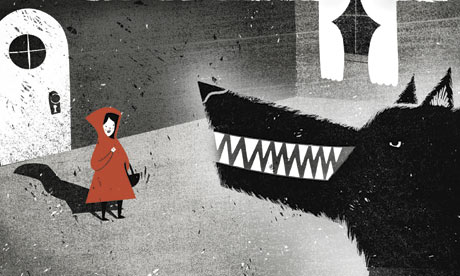
What constitutes transgression changes as much as what constitutes morality. Little Red Riding Hood, in the earliest version, doesn't disobey, she errs, in the most literal sense, wandering away from the path. But in Perrault's tale she isn't warned not to, and so is not punished for heedlessness. She is simply too innocent to know better, and gobbled up by the wolf, without the last-minute rescue by a huntsman to soften the blow for the children listening. The cautionary tale is simple, its lesson clear. The Red Shoes punishes internal transgressions, otherwise known as sins – although Andersen can't tell the difference between venial and mortal sins. But Little Red Riding Hood cautions innocence from the perspective of experience, warning of external dangers. There be wolves. Duly noted.

Today's theme also gives us another four fairy tales to read:

The fairytale of the one-handed murderer by Italo Calvino

The fairytale of Red Riding Hood by Charles Perrault, translated by AE Johnson

The fairytale of the Fisherman and Ifrit from the Arabian Nights, translated by Malcom C Lyons

The fairytale of the Red Shoes by Hans Christian Andersen, translated by Naomi Lewis

The illustrations for this set are by Tyler Garrison.

The Guardian: 'Justice and Punishment'


Today's fairy tale booklet (Day 6) at The Guardian is themed 'Justice and Punishment'. You can read more about the seven part series at my previous post.

Justice and punishment in fairytales: Sarah Churchwell looks at the consequences of fairytale sins. Here's an excerpt:

What constitutes transgression changes as much as what constitutes morality. Little Red Riding Hood, in the earliest version, doesn't disobey, she errs, in the most literal sense, wandering away from the path. But in Perrault's tale she isn't warned not to, and so is not punished for heedlessness. She is simply too innocent to know better, and gobbled up by the wolf, without the last-minute rescue by a huntsman to soften the blow for the children listening. The cautionary tale is simple, its lesson clear. The Red Shoes punishes internal transgressions, otherwise known as sins – although Andersen can't tell the difference between venial and mortal sins. But Little Red Riding Hood cautions innocence from the perspective of experience, warning of external dangers. There be wolves. Duly noted.

Today's theme also gives us another four fairy tales to read:

The fairytale of the one-handed murderer by Italo Calvino

The fairytale of Red Riding Hood by Charles Perrault, translated by AE Johnson

The fairytale of the Fisherman and Ifrit from the Arabian Nights, translated by Malcom C Lyons

The fairytale of the Red Shoes by Hans Christian Andersen, translated by Naomi Lewis

The illustrations for this set are by Tyler Garrison.

Tuesday, October 13, 2009

The Nightingale in Dutch


Just to show that fairy tale books still win awards in other countries, too, here's an article: Flemish writer wins children's book award

Flemish writer Peter Verhelst has won this year's Gouden Griffel (golden slate pencil) award for the best Dutch language children's book for Het geheim van de keel van de nachtegaal (the secret of the nightingale's throat).

The book, a reworking of the Hans Christian Anderson fairytale, is Verhelst's first children's book. He has already published eight volumes of poetry and five novels.

Of course, I tried to find more and discovered this description in English since my Dutch, well, I don't have any Dutch....

Bozar Book Shop description:

In fairy tales, the dreams and wishes of emperors can be become reality with a snap of a finger. In 'The secret of the nightingale's throat' a Chinese emperor dreams of a new Imperial Garden of Gardens. A simple gardener does his very best to make this dream come true. Whenever the emperor hears a nightingale, he knows that its music must also be a part of his garden. The nightingale is willing, but has a will of its own. His music is unique, but cannot be caught. Can the almighty emperor live with the idea that that there is something that excapes his will?

Peter Verhelst has adapted H.C.Andersen's well-known fairy tale into a musical and poetic text. Carll Cneut lets the reader meander through a magical beautiful world.

You can also read more about Peter Verhelst on Wikipedia. (It doesn't mention this book or his award, but someone will probably fix that someday.)

And I believe this is another illustration from the book:

The Nightingale in Dutch


Just to show that fairy tale books still win awards in other countries, too, here's an article: Flemish writer wins children's book award

Flemish writer Peter Verhelst has won this year's Gouden Griffel (golden slate pencil) award for the best Dutch language children's book for Het geheim van de keel van de nachtegaal (the secret of the nightingale's throat).

The book, a reworking of the Hans Christian Anderson fairytale, is Verhelst's first children's book. He has already published eight volumes of poetry and five novels.

Of course, I tried to find more and discovered this description in English since my Dutch, well, I don't have any Dutch....

Bozar Book Shop description:

In fairy tales, the dreams and wishes of emperors can be become reality with a snap of a finger. In 'The secret of the nightingale's throat' a Chinese emperor dreams of a new Imperial Garden of Gardens. A simple gardener does his very best to make this dream come true. Whenever the emperor hears a nightingale, he knows that its music must also be a part of his garden. The nightingale is willing, but has a will of its own. His music is unique, but cannot be caught. Can the almighty emperor live with the idea that that there is something that excapes his will?

Peter Verhelst has adapted H.C.Andersen's well-known fairy tale into a musical and poetic text. Carll Cneut lets the reader meander through a magical beautiful world.

You can also read more about Peter Verhelst on Wikipedia. (It doesn't mention this book or his award, but someone will probably fix that someday.)

And I believe this is another illustration from the book:

Friday, October 9, 2009

Spend Your Holidays with Hans Christian Andersen

A few weeks ago I found this lovely article about traveling in Odense and Denmark with an emphasis on seeing Hans Christian Andersen related sites: Follow Hans Christian Andersen in Odense.

It's really a great article to save if you plan to ever visit Denmark and see some of the Andersen related sites. The recommended sites aren't limited to Odense despite the article title. I've seen many articles of a similar vein, but this is one of the most comprehensive I've seen. I learned a thing or two!

And traveling to Denmark is one of the trips I plan to make one day. The Fairy Tale Road in Germany will come first, but this is on the list.

Spend Your Holidays with Hans Christian Andersen

A few weeks ago I found this lovely article about traveling in Odense and Denmark with an emphasis on seeing Hans Christian Andersen related sites: Follow Hans Christian Andersen in Odense.

It's really a great article to save if you plan to ever visit Denmark and see some of the Andersen related sites. The recommended sites aren't limited to Odense despite the article title. I've seen many articles of a similar vein, but this is one of the most comprehensive I've seen. I learned a thing or two!

And traveling to Denmark is one of the trips I plan to make one day. The Fairy Tale Road in Germany will come first, but this is on the list.

Tuesday, September 15, 2009

The Little Match Girl Passion by David Lang


Did you know that David Lang won the 2008 Pulitzer Prize for Music for his The Little Match Girl Passion? (Here's an iTunes link: Lang: the Little Match Girl Passion if you prefer to listen to samples there instead of Amazon.)

Co-commissioned by Carnegie Hall especially for Paul Hillier and Theatre of Voices, David Lang's The Little Match Girl Passion was awarded the 2008 Pulitzer Prize in Music. Setting Hans Christian Andersen's fable in the format of Bach's St. Matthew Passion, Lang elevates the suffering of the little match girl with poignant, evocative music. Lang's piece is scored for four voices and a few percussion instruments, played by the singers. They sing the sad story of a little girl who freezes to death selling matches on the street during a cold winter's night. In notes Lang wrote to accompany the Carnegie Hall premiere last October, he says he was drawn to Andersen's story because of how opposite aspects of the plot played off each other. 'The girl's bitter present is locked together with the sweetness of her past memories, ' Lang says. 'Her poverty is always suffused with her hopefulness. There's a kind of naive equilibrium between suffering and hope.'

Here are some links to reviews and articles about the composition for your further enlightenment:

David Lang Wins Music Pulitzer

David Lang - The Little Match Girl Passion

Carnegie Hall: The Little Match Girl Passion David Lang

Sounds Heard: David Lang's the little match girl passion

With the cold weather and holidays fast approaching, this sounds like a wonderful addition to a holiday music collection since this is one fairy tale that is very much associated with the winter season.

The Little Match Girl Passion by David Lang


Did you know that David Lang won the 2008 Pulitzer Prize for Music for his The Little Match Girl Passion? (Here's an iTunes link: Lang: the Little Match Girl Passion if you prefer to listen to samples there instead of Amazon.)

Co-commissioned by Carnegie Hall especially for Paul Hillier and Theatre of Voices, David Lang's The Little Match Girl Passion was awarded the 2008 Pulitzer Prize in Music. Setting Hans Christian Andersen's fable in the format of Bach's St. Matthew Passion, Lang elevates the suffering of the little match girl with poignant, evocative music. Lang's piece is scored for four voices and a few percussion instruments, played by the singers. They sing the sad story of a little girl who freezes to death selling matches on the street during a cold winter's night. In notes Lang wrote to accompany the Carnegie Hall premiere last October, he says he was drawn to Andersen's story because of how opposite aspects of the plot played off each other. 'The girl's bitter present is locked together with the sweetness of her past memories, ' Lang says. 'Her poverty is always suffused with her hopefulness. There's a kind of naive equilibrium between suffering and hope.'

Here are some links to reviews and articles about the composition for your further enlightenment:

David Lang Wins Music Pulitzer

David Lang - The Little Match Girl Passion

Carnegie Hall: The Little Match Girl Passion David Lang

Sounds Heard: David Lang's the little match girl passion

With the cold weather and holidays fast approaching, this sounds like a wonderful addition to a holiday music collection since this is one fairy tale that is very much associated with the winter season.

Saturday, September 12, 2009

De Vilde Svaner / The Wild Swans Film


Oh, how lovely and how very much not in English... But at least you can view the trailer and read an article about the new Danish film of The Wild Swans by Hans Christian Andersen, a variant of The Six Swans. Then hope that a DVD release is made available with subtitles someday... From the article Queen of Denmark makes film debut...as an extra.

Face smeared with soot and wearing rags, Denmark's Queen Margrethe debuts as an extra in a film based on a Hans Christian Andersen fairy tale on Friday.

The 69-year-old queen, known for painting, designing ballet costumes, chain-smoking and speaking frankly, will appear in "The Wild Swans" as a poor spectator to the threatened burning at the stake of the film's heroine, Princess Elisa.

"The idea emerged spontaneously as we were all working together on the set," said producer Jacob Jorgensen.

The queen designed sets and costumes for the film, which premieres on Friday, but her minor screen role was only recently revealed.

Andersen's 1838 fairy tale has earlier been adapted for ballet, television, an animated film -- and now a movie.

So I found the trailer and am sharing it with you here but an English one (for which I couldn't find embedding code) is available here: The Wild Swans trailer. Once again, not entirely in English, but beautiful to look at. Here is also a link to the official movie site: De Vilde Svaner. FYI, this is not the first fairy tale film Queen Margrethe has contributed to. She previously contributed to the production of Snedronningen (The Snow Queen), too.

Be sure to watch this one full screen. The details shouldn't be missed.


Leveret af Filmtrailer.com

De Vilde Svaner / The Wild Swans Film


Oh, how lovely and how very much not in English... But at least you can view the trailer and read an article about the new Danish film of The Wild Swans by Hans Christian Andersen, a variant of The Six Swans. Then hope that a DVD release is made available with subtitles someday... From the article Queen of Denmark makes film debut...as an extra.

Face smeared with soot and wearing rags, Denmark's Queen Margrethe debuts as an extra in a film based on a Hans Christian Andersen fairy tale on Friday.

The 69-year-old queen, known for painting, designing ballet costumes, chain-smoking and speaking frankly, will appear in "The Wild Swans" as a poor spectator to the threatened burning at the stake of the film's heroine, Princess Elisa.

"The idea emerged spontaneously as we were all working together on the set," said producer Jacob Jorgensen.

The queen designed sets and costumes for the film, which premieres on Friday, but her minor screen role was only recently revealed.

Andersen's 1838 fairy tale has earlier been adapted for ballet, television, an animated film -- and now a movie.

So I found the trailer and am sharing it with you here but an English one (for which I couldn't find embedding code) is available here: The Wild Swans trailer. Once again, not entirely in English, but beautiful to look at. Here is also a link to the official movie site: De Vilde Svaner. FYI, this is not the first fairy tale film Queen Margrethe has contributed to. She previously contributed to the production of Snedronningen (The Snow Queen), too.

Be sure to watch this one full screen. The details shouldn't be missed.


Leveret af Filmtrailer.com